

Tattoo Guide

Do Fine Line Tattoos Fade? Healing, Aging and Care

Fine line tattoos are delicate by design, so it’s natural to wonder how they’ll look in ten years. The honest answer: all tattoos soften and fade over time, and there’s no reliable research measuring how much faster fine line tattoos change than other styles.

What we do know is that sun exposure, placement, size and aftercare all make a difference. Here’s what the evidence says, what it doesn’t, and how to keep a fine line tattoo looking crisp.
Key Points

  • No reliable studies compare how fast fine line tattoos fade. Treat bold statistics online with caution.
  • Sun can fade tattoo inks, so protect healed tattoos with sunscreen.
  • Placement matters: fingers, hands and feet fade easily.
  • Size matters: tiny, very detailed designs need enough space to stay readable.
  • Blowouts, where ink spreads under the skin, show as a blurry halo around lines.
  • Good aftercare helps your tattoo heal cleanly.

What the Research Says (and Doesn't)

We searched medical and scientific databases for studies on fine line tattoo longevity and found none. We also found no peer-reviewed study comparing how quickly colour and black ink fade. Figures you may see online, such as a percentage of fine line tattoos needing touch-ups within a few years, don’t come from credible research.

So rather than guess, this guide sticks to what trusted sources support, plus practical experience about placement and size.

Sun Exposure

Sun is the factor with the strongest backing. The American Academy of Dermatology says UV light can fade some tattoo inks and recommends broad-spectrum, water-resistant sunscreen of SPF 30 or higher on tattoos in the sun. Germany’s Federal Institute for Risk Assessment notes that sunlight can break down some coloured pigments.

  • While healing: keep the tattoo out of direct sun.
  • Once healed: use sunscreen every time you’re outdoors and avoid tanning beds.
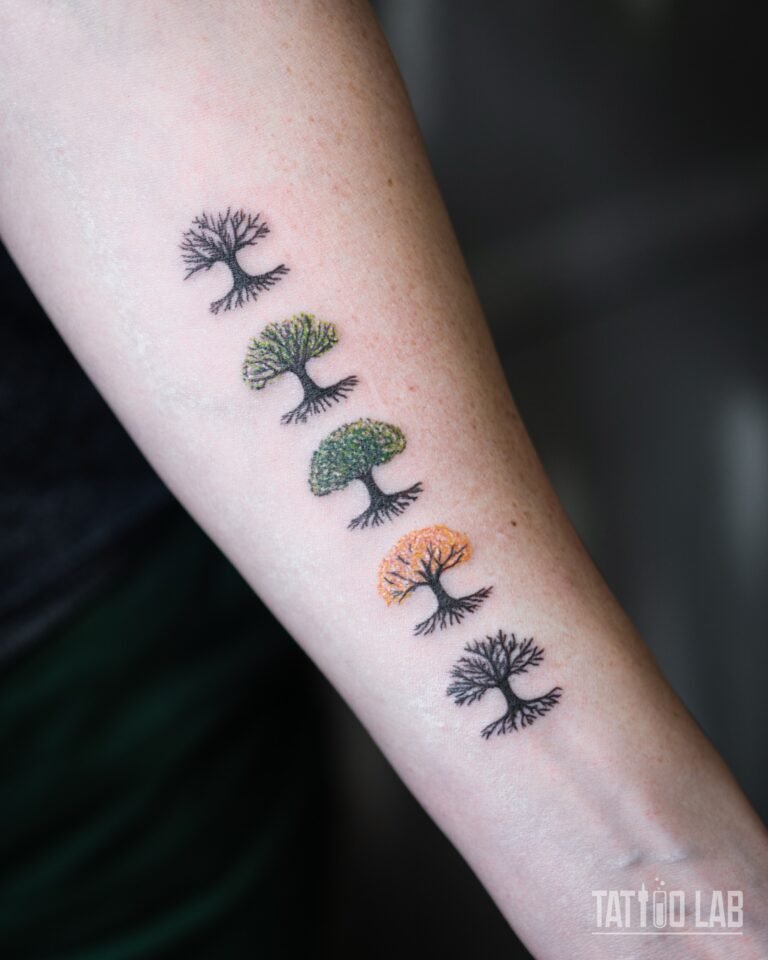
Fine line tattoo of five small rooted trees in seasonal colours running down the inner forearm

Tattoo Blowouts

A blowout happens when ink spreads deeper into the skin than intended, creating a blurry halo around the lines. A dermatology review of 16 cases describes blowouts as a permanent, painless halo of colour around tattoo lines.

Blowouts show up most on fine, crisp lines, which is one reason fine line work takes a steady, experienced hand. Look closely at healed fine line work in any artist’s portfolio before you book.

Placement and Size

  • Fingers, hands and feet fade easily. At Tattoo Lab, complimentary touch-ups aren’t guaranteed in those areas for that reason.
  • Give detail room. Tiny lettering and very fine detail can blur together as lines soften over the years. Your artist may suggest making a design slightly larger or simpler so it stays readable.
  • Think about sun and rubbing. Areas that get lots of sun, or constant contact with clothing and straps, may need more care.

Browse healed and fresh examples on our fine line tattoos page.

Healing a Fine Line Tattoo

Fine line tattoos heal like any other tattoo, and a clean heal helps the lines stay sharp. Follow our tattoo aftercare guide:

  • keep the second-skin bandage on for 24–48 hours unless your artist advises otherwise
  • wash gently twice a day with mild, fragrance-free soap and moisturise lightly
  • don’t pick, peel or scratch, even when it itches
  • avoid swimming, bathtubs, hot tubs and the ocean for at least 2–3 weeks
  • keep it out of direct sun while it heals

A healing tattoo can look cloudy for a while as new skin forms. That’s normal.

Touch-Ups

If part of your tattoo heals unevenly or doesn’t hold ink, your artist checks it and offers a complimentary touch-up when it’s genuinely necessary. Touch-ups aren’t guaranteed and have no fixed time window. They don’t cover natural fading over time, which depends on skin type, aftercare, sun exposure and ageing, or damage from picking or scratching. Fingers, hands and feet fade easily, so complimentary touch-ups aren’t guaranteed there.

Do Fine Line Tattoos Hurt Less or Cost More?

Pain: we didn’t find research comparing pain between styles. In a study of 1,092 people, longer sessions were linked with more pain, so small fine line pieces may feel easier simply because they’re quicker. Read does getting a tattoo hurt?

Cost: price depends on size, detail and placement rather than the style name. See tattoo prices.

Fine Line Tattoo Questions

There’s no reliable research measuring that. All tattoos soften over time. Sun protection, good aftercare, sensible placement and a size that suits the detail make the biggest difference.

Lines can soften as skin ages, which is why very small, detailed designs need enough space. A blowout is different: ink spreads under the skin and creates a blurry halo.

Fingers, hands and feet fade easily, so many people choose areas like the forearm, upper arm or collarbone. Protecting the tattoo from sun helps wherever it is.

If an area heals unevenly or loses ink during healing, your artist may offer a complimentary touch-up when it’s genuinely necessary. Natural fading over time isn’t covered, but a refresh can be booked as a new appointment.

We didn’t find research comparing styles. Smaller pieces take less time, and longer sessions were linked with more pain in one study.

Yes, once it has healed. The AAD recommends broad-spectrum sunscreen of SPF 30 or higher. While healing, keep it out of direct sun instead.

Planning a Fine Line Tattoo?

Send us your idea, and your artist will help you choose a size and placement that keep it looking crisp.

Sources

  1. Caring for tattooed skin. American Academy of Dermatology.
  2. Questions and answers about tattoo inks. German Federal Institute for Risk Assessment, 2025.
  3. Blurry halos after tattooing (tattoo blowouts): a review of 16 cases. Kluger, Journal of the European Academy of Dermatology and Venereology, 2018.
  4. Tattoo Aftercare Tips From a Dermatologist. Cleveland Clinic Health Essentials, 2026.
  5. Gender Differences in Subjective Pain Perception during and after Tattooing. Witkoś and Hartman-Petrycka, International Journal of Environmental Research and Public Health, 2020.

This guide is general information, not medical advice. Always follow your artist’s aftercare instructions.

Book Now!

Fill in the Contact form

Book Now!

Fill in the booking form

Get in Contact!