

Tattoo Guide

Your First Tattoo: What to Expect and How to Prepare

Getting your first tattoo is exciting, and a little nerve-racking if you don’t know what happens. This guide walks you through every step: choosing a design and a studio, preparing for your appointment, what it feels like, and how to look after your new tattoo.

It’s written by Tattoo Lab, a tattoo and piercing studio in Halifax, Nova Scotia, with links to trusted health sources where it matters.
First Tattoo Checklist

  • Choose a design you love and a style that suits it, then look for an artist whose portfolio matches.
  • Choose a safe studio with a Nova Scotia Body Art Facility Permit.
  • Book a consultation. At Tattoo Lab, consultations are free for most tattoos.
  • Bring photo ID and eat a proper meal before your appointment.
  • Skip alcohol beforehand, and don’t use numbing products without advice.
  • Start your aftercare as soon as you leave the studio.

Choose Your Design and Style

Start with what the tattoo means to you. In a large US survey by Pew Research Center, 69% of tattooed adults said honouring or remembering someone or something was a reason for at least one of their tattoos. Others simply love a design, a style or a symbol.

  • Collect references: photos, drawings, words or a font you like.
  • Pick a style: fine line for delicate designs, realism and black and grey for detailed shading, or colour for bold pieces.
  • Think about placement: where you’ll see it, whether you want to cover it for work, and how much room the design needs.
  • Think about size: detailed designs need enough space to stay clear as skin ages, and your artist will recommend a size.
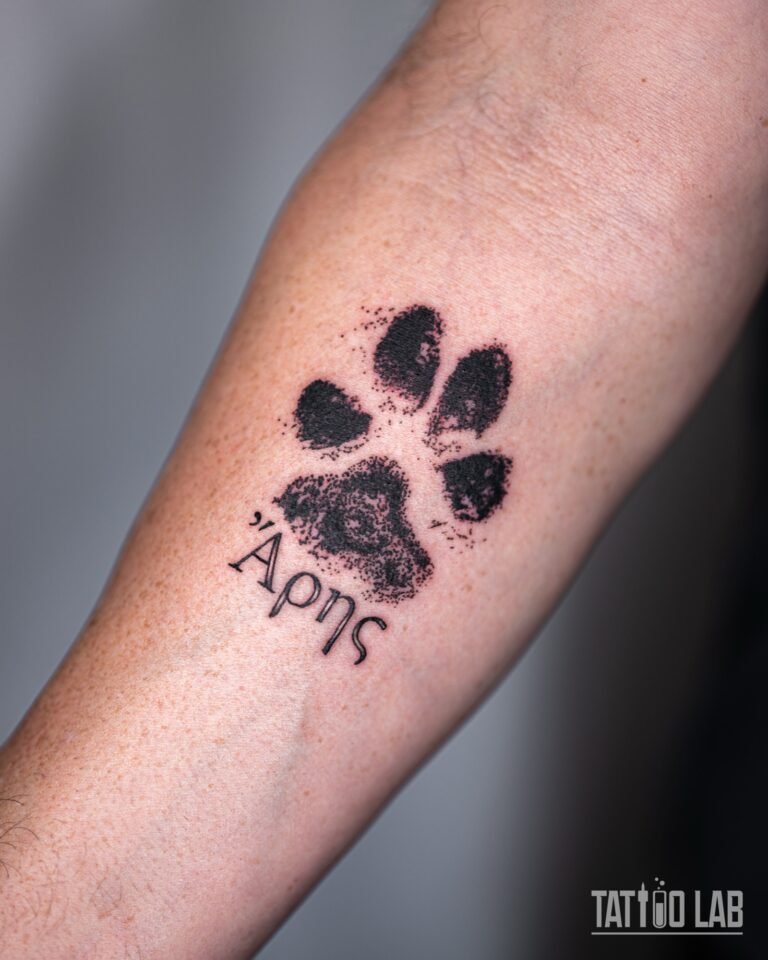
Small paw print tattoo with a stippled ink-stamp texture and short Greek lettering on the inner forearm

Choose a Studio You Trust

Look for a studio whose work you love and that follows Nova Scotia’s safety rules: a posted Body Art Facility Permit, trained artists, sterile single-use needles, a consent form and written aftercare. Our checklist explains each point: how to choose a safe tattoo studio in Halifax.

Book and Plan Your Tattoo

At Tattoo Lab, booking works in four steps:

  1. Send your idea through the Book Now form or text 902-448-2211.
  2. Plan the design with the right artist. Consultations are free for most tattoos.
  3. Confirm your date with a deposit. Deposits vary by tattoo and appointment, your artist confirms the amount, and they go toward your final price. They are non-refundable, and with at least 7 days’ notice your deposit moves to a new date.
  4. Get tattooed and follow your aftercare.

Prices depend on size, detail and placement. See tattoo prices and how booking works. Want something small and simple sooner? Ask about walk-in tattoos.

How to Prepare for Your Appointment

  • Bring ID. All clients need valid government-issued photo ID showing their date of birth. Tattoos are 16+, and clients aged 16–17 need a parent or legal guardian present for the entire session.
  • Eat and rest. Have a proper meal beforehand, get a good night’s sleep and bring water and a snack for a longer session.
  • Skip alcohol. Come to your appointment sober. In one US survey, tattoos done while impaired were more likely to be regretted later.
  • Wear the right clothes. Choose comfortable, loose clothing that gives easy access to the placement and won’t rub afterwards.
  • Look after the skin. Nova Scotia’s Safe Body Art Standard doesn’t allow tattooing over infected, sunburned, broken or irritated skin, so avoid sunburn before your appointment. If there’s a mole in the area, the American Academy of Dermatology suggests keeping the tattoo away from it.
  • Ask before using numbing products. The US Food and Drug Administration has warned about some high-strength numbing products marketed for tattoos. Talk to a pharmacist or doctor first, and tell your artist.

What Happens at Your Appointment

  1. Paperwork: you’ll show your ID and sign a consent form. Nova Scotia requires studios to have clients sign a client awareness form.
  2. Final design: your artist confirms the design and size with you.
  3. Stencil: the design is placed on your skin so you can check the position before any tattooing starts. Speak up if you want it moved.
  4. Setup: your artist prepares the area, puts on fresh gloves and opens sterile, single-use needles or cartridges.
  5. Tattooing: the time depends on the size and detail. For longer sessions, ask for a short break if you need one.
  6. Covering and aftercare: your artist covers the tattoo and explains how to look after it.

Does Your First Tattoo Hurt?

Everyone feels it differently. In a survey of 1,092 tattooed adults published in 2020, people rated their pain during tattooing at 4.35 out of 10 on average, and 2.07 right afterwards.

In that study, broad body areas (arms, legs, torso, neck) didn’t significantly change how painful tattooing was, while longer sessions, bleeding and stress were linked to more pain. Read more in does getting a tattoo hurt?

Aftercare Starts Right Away

Your tattoo is healing skin, and the first weeks make a big difference to how it looks for years. Our tattoo aftercare guide covers every step, including:

  • keeping your second-skin bandage on for 24–48 hours, unless your artist advises otherwise
  • washing gently twice a day and moisturising lightly
  • avoiding swimming, bathtubs, hot tubs and the ocean for at least 2–3 weeks
  • keeping it out of direct sun while it heals
  • not picking or scratching, even when it itches

See a doctor if you notice fever, spreading redness, pus, a bad smell, worsening pain or red streaks.

Will You Love It Forever?

Most people do. In a 2024 survey of Canadians by Halifax-based Narrative Research, about three-quarters of tattooed Canadians said they were happy with their tattoos, and very few wanted them removed. A 2023 Pew Research Center survey found that 24% of tattooed US adults had ever regretted a tattoo.

Taking your time on the design, choosing the placement carefully and working with an artist whose style you love are the best ways to be in the happy majority.

First Tattoo Questions

A design that means something to you, in a size and placement you’re comfortable with. Many people start with a small fine line piece, a word or a symbol, then go bigger once they know what to expect.

It depends on the size and detail. A small, simple tattoo is much quicker than a detailed piece. Your artist will give you an idea of timing when you plan the design.

Comfortable, loose clothing that gives easy access to the tattoo area and won’t rub it afterwards.

Talk to a pharmacist or doctor first, and tell your artist. The US FDA has warned about some high-strength numbing products marketed for tattoos, and Health Canada’s labelling standard doesn’t cover numbing before cosmetic procedures.

No. Please come to your appointment sober. In one US survey, tattoos done while impaired were more likely to be regretted later.

It depends on the size, detail and placement. See our tattoo prices page, and send your idea for a quote. Consultations are free for most tattoos.

Ready for Your First Tattoo?

Send us your idea, even if it’s rough, and we’ll help you plan a first tattoo you’ll love.

Sources

  1. Gender Differences in Subjective Pain Perception during and after Tattooing. Witkoś and Hartman-Petrycka, International Journal of Environmental Research and Public Health, 2020.
  2. 32% of Americans have a tattoo, including 22% who have more than one. Pew Research Center, 2023.
  3. One third of Canadians have tattoos, and most have no regrets about getting them. Narrative Research, 2024.
  4. Think Before You Ink: Perception, Prevalence, and Correlates of Tattooing and Tattoo Regret in US Adults. Morlock and Morlock, Cureus, 2023.
  5. FDA warns consumers to avoid certain topical pain relief products. US Food and Drug Administration, 2024.
  6. Topical Anaesthetic/Analgesic/Antipruritic Labelling Standard. Health Canada, 2015.
  7. Nova Scotia Safe Body Art Standard. Nova Scotia Department of Health and Wellness, 2018.
  8. Safe Body Art Regulations, N.S. Reg. 39/2018. Province of Nova Scotia.
  9. Do tattoos cause skin cancer? American Academy of Dermatology, 2025.

This guide is general information, not medical advice. Always follow your artist’s aftercare instructions, and ask a doctor or pharmacist about medicines, numbing products or health conditions.

Book Now!

Fill in the Contact form

Book Now!

Fill in the booking form

Get in Contact!